513.772.5115

Home

About Us

Leadership
Development
Program

Coaching ROI 

Selecting a Coach

The Process

Coaches

Fees

Test Drive

Contact


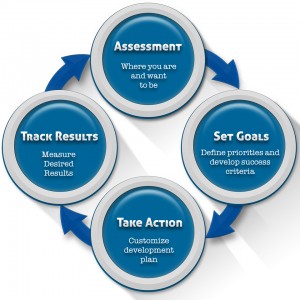
Process insures consistency and also delivers end results. We customize the process for each individual, since every client is unique as well as each company's goals for the leader.  There are many ways to provide executive coaching, however we feel that the "process" is key to behavior change. 

In order to fit the right process to the leader, an assessment is crucial to pinpoint the key areas for executive development. Assessments can be done many ways, however we typically use in-depth interviews and/or 360º multi-rater assessments. The 360º is selected based upon the competencies the leader, the stakeholders involved, and manager' recommendations. If you have already employ 360's and other assessments we will review those tools and determine if they provide enough information to focus on the key areas for improvement. If not, we will carefully pick assessments that will give us the needed data. 

One process we often follow is based upon many of Marshall Goldsmith's principles. Recently the American Management Association named Dr. Goldsmith as one of 50 great thinkers and leaders who have influenced the field of management over the past 80 years and Business Week listed him as one of the most influential practitioners in the history of leadership development. Marshal is probably the #1 Executive Coach in the US and we have personally worked with him.  

The following is a typical process that can take from three to nine months:

Step 1 – Buy-In
The coach helps the leader identify the characteristics and qualities that are important for a leader in his/her business. He helps the leader understand the payback for improvement to the company as well as to the leader.  This step is always done in person. 

Step 2 – Identify Stakeholders
Leaders identify stakeholders who can provide balanced feedback in the assessment process and potentially in the developmental process. They become part of the leader's team. The leader must be involved in this decision to insure that feedback they receive will be accepted.

Step 3 – Conduct Assessment
The coach selects an assessment method for the coaching. Sometimes it can be done by interview and discussion. Often 360º feedback instruments are used with a social-style or an emotional intelligence assessment of the leader's behavioral style characteristics. The coach may also get the stakeholders to elaborate their 360º feedback. The coach may also conduct confidential interviews with various stakeholders to get additional data and feedback about the leader. 

Step 4 – Review Assessment and Develop Change Plan
The coach and the leader meet to review and discuss the results of the assessment. A comprehensive and confidential report is provided to the leader. Together they analyze the data and identify key strengths and weaknesses. Together they select 1-2 weaknesses to focus on together.  They also determine which stakeholders in the assessment process should be involved in the leader's development plan. The leader's manager or Human Resources is consulted for approval and support.  

Step 5 – Collect Feedback from Stakeholders
The leader and stakeholders meet to discuss the key weaknesses.  Stakeholders are asked to provide feedback and suggestions on how to improve. When successful people develop and express these goals to others and involve the stakeholders in their development, measurable change is much more likely to occur.

Step 6 – Develop and Implement Action Plan
After the stakeholders meetings, the coach and leader develop an action plan with specific and measurable outcomes based on the input and ideas from the stakeholders. The coach will work with the leader on his/her development plan to provide guidance and or training.  If training is required, we use books, action learning projects, online courses, other appropriate individualized instruction and tools. The action plan will be reviewed monthly and revised according to the leader’s progress. Regularly schedule face-to-face coaching session will as required. Telephone meetings are also scheduled to provide encouragement and reinforcement.

Step 7 – On-going Stakeholder Feedback
The leader and stakeholders will meet on a monthly basis to provide 30-day additional feedback and additional suggestions. A mentoring relationship will be developed between stakeholder and leader. Depending on the stakeholders’ feedback, the coach may adjust the action plan regularly.

Step 8 – Evaluation
Short surveys to stakeholders are used the midpoint and at the end of the coaching engagement. These surveys are designed to assess the stakeholders’ attitudes and evaluation of the leader’s improvement during the coaching period.


  Back to Top 

Call us at 513.772.5115 or email

Home | About us | Selection | Approach | Coaches | Fees | Contact

©Professional Learning System 2008